
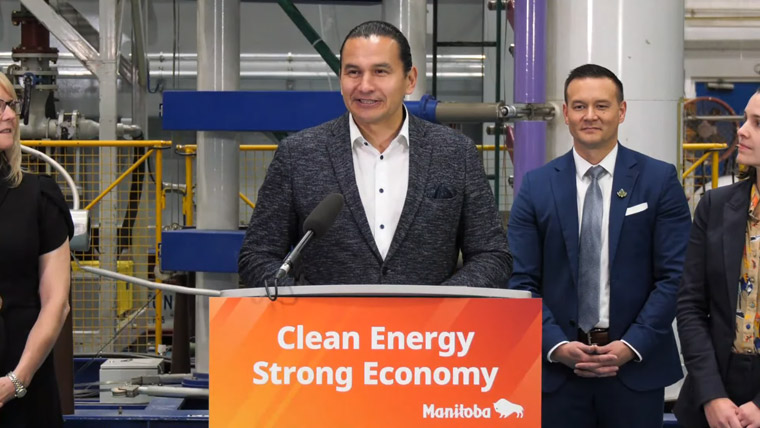
The Manitoba government is calling for all provinces and territories across Canada to protect Canadian energy security and to promote Manitoba’s clean hydroelectric power.
“To Trump-proof our economy we need to work together as provinces and territories to build up this country we all love so much,” said Premier Wab Kinew. “By joining this national call for a grid, we’re making sure Manitoba has the power it needs to grow, create good jobs, export more of our own clean energy east and west, and shield our economy from global uncertainty. This is about building a future where Manitobans can count on affordable, clean electricity and a resilient economy.”
The September 2024 Affordable Energy Plan identified energy exports to ensure the best value for Manitobans under the Integrated Resource Plan and highlighted new possibilities to partner with other provinces and the federal government to strengthen Canada’s grid.
Expanded and modernized interprovincial transmission lines, developed in partnership with other provinces and the federal government, would help secure power grids across the country and strengthen Canada’s energy security, the premier noted. For Manitoba, enhanced interties – transmission interconnections linking neighbouring electric utility systems, allowing them to share and trade electricity – would also provide valuable import capacity during periods of peak demand or unexpected system stress.
“Manitoba is proud to join this national partnership to advance clean, reliable and affordable electricity across Canada,” said Environment and Climate Change Minister Mike Moyes. “Our province has long been a leader in renewable energy and we remain committed to building a future where electricity is sustainable and accessible to all. Working toward a national electricity grid supports Manitoba’s Affordable Energy Plan by strengthening interprovincial collaboration, protecting ratepayers and ensuring Indigenous communities are full partners in the energy transition.”
Under the Ontario-led MOU, provinces and territories can work through electricity system operators and utilities to co-ordinate planning, share information and jointly engage the federal government on regulatory and funding support.
It is also an opportunity to ensure Indigenous participation and Canadian supply chains are central to advancing transmission projects, the minister noted.