Art Kroeker
Obituary
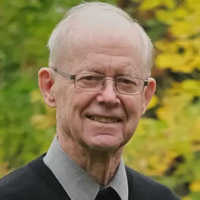
Art Kroeker, aged 96 years, of Winnipeg, MB., passed away on Wednesday, January 21, 2026, at Health Sciences Centre, Winnipeg, MB.
Wilma, his wife of 27 years, survives him, as well as his children and their families, and her children and families. His children are: Tim (and Janet), Allan (and Gloria), Lori (and Dave) Neufeld, Brent (and Kristen), Evan (and Pattie Chalmers). He has 13 grandchildren and 12 great-grandchildren. Wilma’s children are: Alison (and Kim) Weymouth, Marsha (and Jack) Miller, Norman and Cynthia Warkentin, son-in-law David Eastwood. She has 6 grandchildren and 8 great grandchildren. He also leaves his brother Gordon (Norma) (South Carolina) and sister Doris (and Bill) Van Berkel (Ontario). Art was predeceased by our mother, Romelda, in 1996, and by his sister Helen Smith.
Arthur Harold was born in Steinbach in 1929, barely a month before the big stock market crash. We would occasionally tease him about that, as if there were some connection, but back in those days, no community was immune from the effects of the Great Depression, including Steinbach. So, his early childhood was one, not of privation exactly, but certainly one in which families made do. It was a small, tight knit community with many supports. The Kroeker and Reimer (his mother’s) families were large, so many cousins were constantly at hand. “Home made” was that era’s watchword, and that included making your own fun! Dad’s memories of the cousins’ games and hijinks of those years often revolved around the mostly unfettered access the kids had to the vast Reimer department store on Main Street… an unending supply of the era’s goods and services, presided over by uncles and aunties in the different departments, some more lax and good humoured than others. Being inventive and nimble footed meant hours of creative play opportunities.
In his early years, their family lived in his widowed grandfather’s large home, apparently one of the few, perhaps the only home in town with amenities like indoor plumbing. An eccentric bachelor uncle lived on the upper floor. Dad’s mother ran the home and cared for her own family, as well as for her brother and father. Here, too, by Dad’s description, the place was often alive with cousins. His grandpa must have been a genial man; he was certainly one of the wealthiest men in town, but one thing he did not possess was teeth, nor dentures apparently, so the little kids in the household were the lucky recipients of anything Grandpa’s gums couldn’t handle…presumably before he had a go at them. All told, it was an idyllic childhood, which continued when the family was able to move into their own house on a small farm on what is now the southeast edge of Steinbach.
For us, one interesting aspect of Dad’s school career was how he and our mom came into each other’s orbit. She was younger and from a different social set, but we were told he was considered something of a catch. And eventually he was caught, but not before he left school after Grade 11, and seeking broader horizons and adventure, enrolled in the “Normal School” (now housing CMU) in Winnipeg, for a crash teacher training course. From there, it was off to Norway House at the north end of Lake Winnipeg. His friend Jake taught in the other room of the two-room school, and together they kept house through a frigid winter. There was not much in the walls to break the wind, which may have been the inspiration for a description of a strong winter wind he liked to use. “It’s a lazy wind”, he would say… “Too lazy to go around, so it goes straight through you”. They survived… more than survived actually. Art talked about that experience in the community and with his First Nations students as a very good year and an education for him. He was only 18 years old. In the spring, a group of academics invited him to join them as they canoed the Nelson River to Hudson Bay. This was probably the beginning of a love for back country canoeing, which re-emerged a few years later when we older boys (Tim and Allan) were considered old enough to pull our weight on canoe-camping trips.
Back after his time in the North, Art started a career with the JR Friesen Ford dealership in Steinbach, first as a fuel truck driver, then in the dealership, taking on increasing levels of responsibility. By 1955, he was tapped to be the manager of their BA filling station in Morris, and shortly after that, their satellite Ford dealership. So, our family relocated to Morris… yant zeed, “the other side” (of the Red River) as it was referred to by low German Mennonites east of the Red. Art quickly got involved in community affairs, while managing a growing business, and family. Two more kids (Lori and Brent) joined the fold, life was busy. By 1963, though, he was ready for a career change. He joined Investor’s Group as a sales representative, later a financial advisor and manager. His 40-year career with that company was a perfect fit for a person of his talents. He was committed to providing solid financial products and advice to his clients and to mentoring others in the company at earlier stages in their careers. Eventually, he achieved something like emeritus status at Investors. Meanwhile at home, fiscal prudence and financial planning principles were imparted to us, as well… with mixed success.
Moving to south Winnipeg in 1965 was an adventure with new challenges for us all. In later years, Dad would tell how he had screwed up his courage and bought a $25,000! mortgage on a new house on Agassiz Drive… a huge step for a young man with a growing family (Evan, a year later). He and Mom settled on a church home at Fort Garry Mennonite Brethren, a new congregation at that time, and a significant departure from their previous church experiences. This was his church home for 60 years. He and our family were nurtured and loved there, and he in turn contributed to the church’s life in many ways.
In the mid 1970s, with his friend, Toby Voth, Art purchased an island on Shoal Lake, part of Lake of the Woods, and each proceeded to build a family cottage. A lot of great family times happened there. Our mother’s passion was bird watching, Dad was more water oriented, exploring the labyrinth of islands, old mine sites and nearby communities. This cabin was a big improvement on their first venture on Laclu, where the conditions were rustic, to put it mildly. A later cabin on West Hawk Lake, was again a magnet for Art and Wilma in the warmer seasons, as well as for the extended family. By this point, in retirement, Art was able to fully develop his inner explorer. Global travel became part of their yearly schedule, when not at the cabin or at Wilma’s condo in northern Washington. The world map on their wall was crowded with pushpins showing countries visited. “I’ve Been Everywhere, Man” was their theme song. They had initially met as travellers in Paraguay… he as an assistant tour guide, she as a participant. They were well matched in love of travel, exploring new cultures, making new friends.
Quite often, travel dovetailed with Art’s other passion… Mennonite history and genealogy. Trips to the Netherlands, Poland, Germany, Switzerland, Russia, Ukraine, South and Central America … all were taken in large part to make Mennonite or Anabaptist connections, past and present. Sometimes to track down distant relatives or the gravesites of ancestors or their villages of origin. These trips were well documented and shared with the family, an invaluable part of his legacy for us. As an amateur historian, our more recent family history in Manitoba consumed a lot of his energy, as well. So, for many years he was a strong supporter of the Mennonite Heritage Village, helping to raise awareness and financial support. And, every spring, he and Wilma would do their best to spruce up the little tin smith’s shop at the MHV, which was filled with artifacts from the old Reimer family store. It was a little piece of family history he didn’t want to see forgotten. Maybe not quite as popular with the kids as the penny candy at the village general store, but still interesting in its own way.
Art had a facility with language and as many will confirm, knew how to spin a yarn. Choose the language, high or low German, or English, he was comfortable in each. But Plautdietsch storytelling seemed especially fascinating to us, listening in, even though we may have only understood a fraction. He mined Steinbach’s history and colourful characters for material and never seemed to repeat himself. His timing was impeccable and since he usually had himself in stitches by the time the story hit its highpoint, it was hard not to join the hilarity, whether or not you understood a word. Humour aside, he loved digging below the surface narratives of family and community histories to find the anecdotes and through lines that brought our forebears to life in new ways. These he shared with children and grandchildren, orally and in print, leaving us with a more meaningful connection to our family’s past. We knew he loved doing this and he was so good at it, preserving and making alive our heritage.
We will remember Art as a loving and supportive father, grand and great grandfather. He was our go-to for sound advice throughout our lives and we benefitted from his wisdom and experience til the end of his. He was a loving and caring partner for Wilma, especially as they aged and their physical capacity diminished. They were determined to continue living independently and were able to do with some supports. They were models for our family in the steady faith he and Wilma lived out, and in their mutual, affectionate caring.
Art lived his entire life with quiet, confident faith in the love of God and Jesus Christ, with the assurance that that love had carried him through all his years and would after his death. It was reflected in his life journey and in all his relationships. He often expressed to us deep gratitude for the long life he had been given, with all its joys, opportunities and challenges. He taught and showed by example that a life so blessed should create a response of giving from our personal and material resources. We are thankful for this legacy of faith and faithfulness.
The celebration of life will be held on Friday, January 30, 2026, at 11:00 a.m., at Fort Garry Mennonite Brethren, 1771 Pembina Hwy, Winnipeg, MB.